

Why We Build Where We Build: The Texas Hill Country
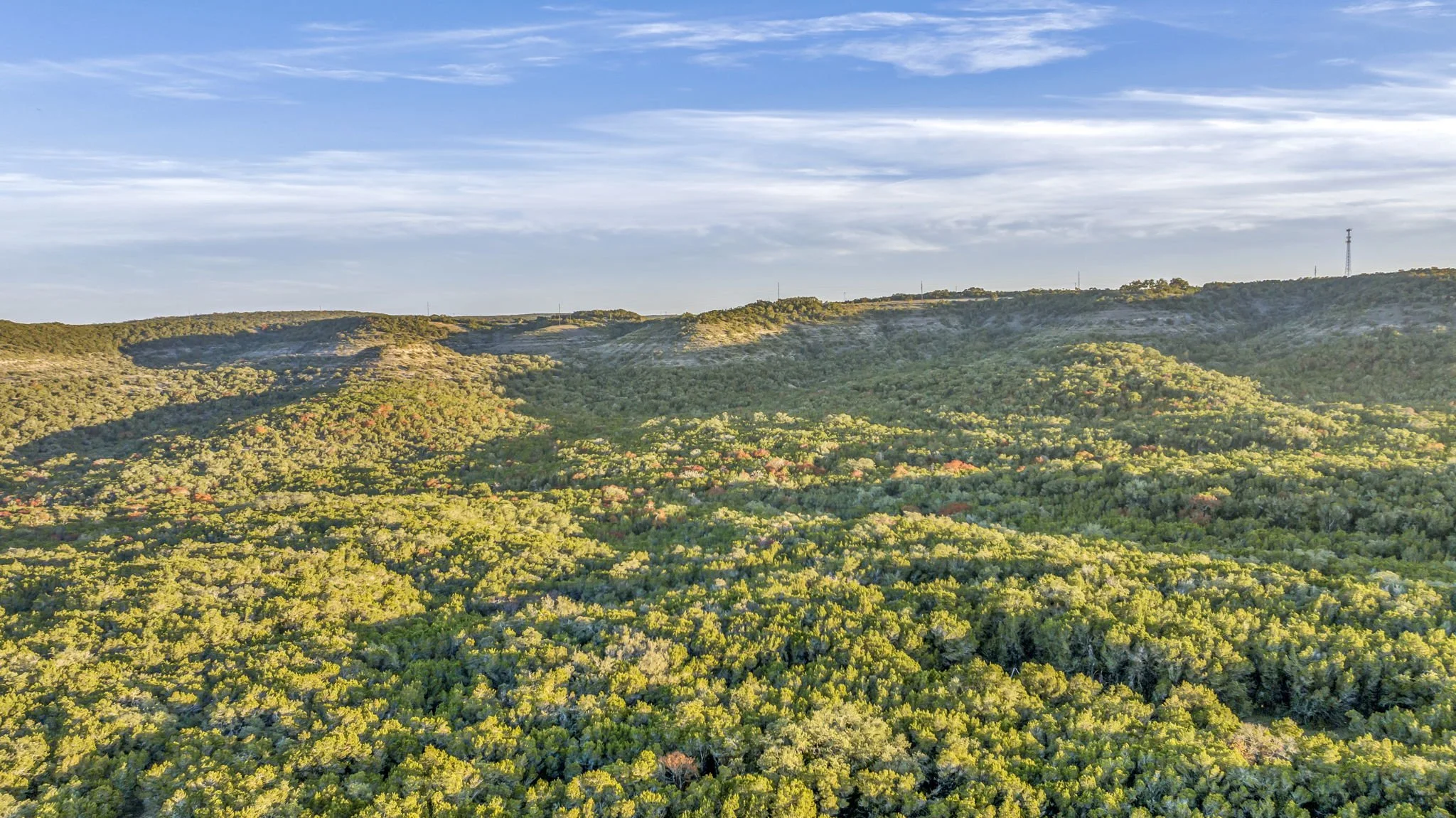
There are mornings in the Hill Country that stop you. Not in a dramatic way — just a pause. The light comes up differently here. Slower. More deliberate. And if you are standing on a ridge at the right hour, watching it spread across the limestone and cedar, you understand something without being able to explain it.
That is where RanchesAt begins. Not in a conference room. Not in a spreadsheet. It begins on land like this.
Kim and I have spent enough time in cities to know what we were trading when we chose the Hill Country. We have also spent enough time on our own ranch to know what we gained.
The Land Chooses You
People ask why we focus exclusively on this region — why not expand into other parts of Texas, or other states entirely? The honest answer is that we have not found anywhere else that does what the Hill Country does.
It is not just the views, though the views are extraordinary. It is the quality of the land itself. The variety of topography — hilltops with long-distance vistas, creek valleys, limestone outcroppings, dense hardwood groves. It is land with character. Land that rewards the people willing to steward it.
In four years of developing RanchesAt communities — Sentinel Peak, Big Mountain, Dripping Springs, and Canyon Crossing — every decision we have made has started with the same question: what does this land want to be?
That sounds like an odd thing to say about real estate. But it shapes everything. The way we design road systems is to minimize disruption. The way we hand-clear terrain rather than scrape it. The way we establish wildlife exemptions is not because they reduce taxes — though they do — but because wildlife management is the right way to care for land like this.
Protecting What Makes It Special
The Texas Hill Country is not limitless. The properties that exist the way ours do — large, low-density, with real privacy and real views — are genuinely rare. The land that has not been over-developed, subdivided too small, or stripped of its native character is becoming harder to find with every passing year.
That scarcity is not lost on us.
When we search for a new development site, we spend months on it. We walk the land in every season. We study the elevation, the soil, the water, and the wildlife corridors. We look at what surrounds the property — what conservation land, what parks, what natural buffers exist to protect it for the long term.
How Each Community Reflects That Philosophy
At Sentinel Peak, the community is bordered mostly by conservation land, with a 500-plus-acre Blanco River Park along the entire northern boundary. At Big Mountain, we are positioned on the commanding ridge above Round Mountain, with elevations over 1,400 feet. At Dripping Springs, the 389-acre spread offers views from 1,600-foot elevations, with a wildlife exemption across the entire community. At Canyon Crossing, dense hardwoods and hilltops reaching 1,200 feet create a natural privacy that is nearly impossible to manufacture.
These are not features we engineered. They are features we chose to protect.
Building With Purpose
Kim and I did not come to this work from a background in residential land development. I spent 18 years building Cardtronics into a global operation before we launched Clinard Properties in 2014. That experience gave me a set of skills — scale, discipline, execution, accountability. But it also clarified something.
Building a company is meaningful. Building a legacy is different.
RanchesAt exists at the intersection of both. Every community we develop is an exercise in discipline — the right density, the right lot sizes, the right infrastructure, the right stewardship practices. And every community is also an act of faith that families who buy here will build something that outlasts the transaction.
That is what motivates us. Not the square footage. Not the price per acre. The image of a family standing on their porch at sunset, watching the same light we watch every morning, knowing they have built something worth keeping.
Explore the RanchesAt Communities
If you are looking for land in the Texas Hill Country — land with real views, real privacy, and the kind of infrastructure that makes building easy — we would welcome the chance to show you what we have built. Each RanchesAt community is distinct. Each one is worth seeing in person.
FAQ
Q: What makes RanchesAt different from other Texas Hill Country land developers?
A: RanchesAt focuses on low-density, luxury ranchette communities where every homesite is designed for views, privacy, and long-term land stewardship — not maximum lot count.
Q: Where are RanchesAt developments located?
A: RanchesAt operates four Texas Hill Country communities: Sentinel Peak near Wimberley, Big Mountain near Marble Falls, Dripping Springs west of Austin, and Canyon Crossing between Wimberley and Canyon Lake.
Q: Do RanchesAt properties have wildlife exemptions?
A: Several RanchesAt communities carry a community wildlife exemption, including Dripping Springs and Big Mountain, which helps reduce the property tax basis for owners.
Q: How large are RanchesAt homesites?
A: Lot sizes range from 8 to 98 acres, depending on the community — large enough to ranch at a meaningful scale, manageable without a full-time staff.